

MÕNAI is a standalone portable multitimbral synthesizer that goes wherever your creativity takes you. The integrated battery eliminates the need for power outlets, while the compact form factor fits comfortably in a backpack. Whether you’re sketching ideas on location or performing on stage, MÕNAI delivers comprehensive synthesis capabilities without compromise.
Planned beta version release: Summer 2026


Every control on MÕNAI is positioned for intuitive access. The 8 endless encoders provide tactile feedback without physical limits, letting you sweep through parameters naturally. Touch-sensitive strips respond to the subtlest gestures – the left strip dedicated to modulation, the right offering multi-touch control across 20cm of expressive surface. The 2-axis joystick adds another dimension of real-time control.
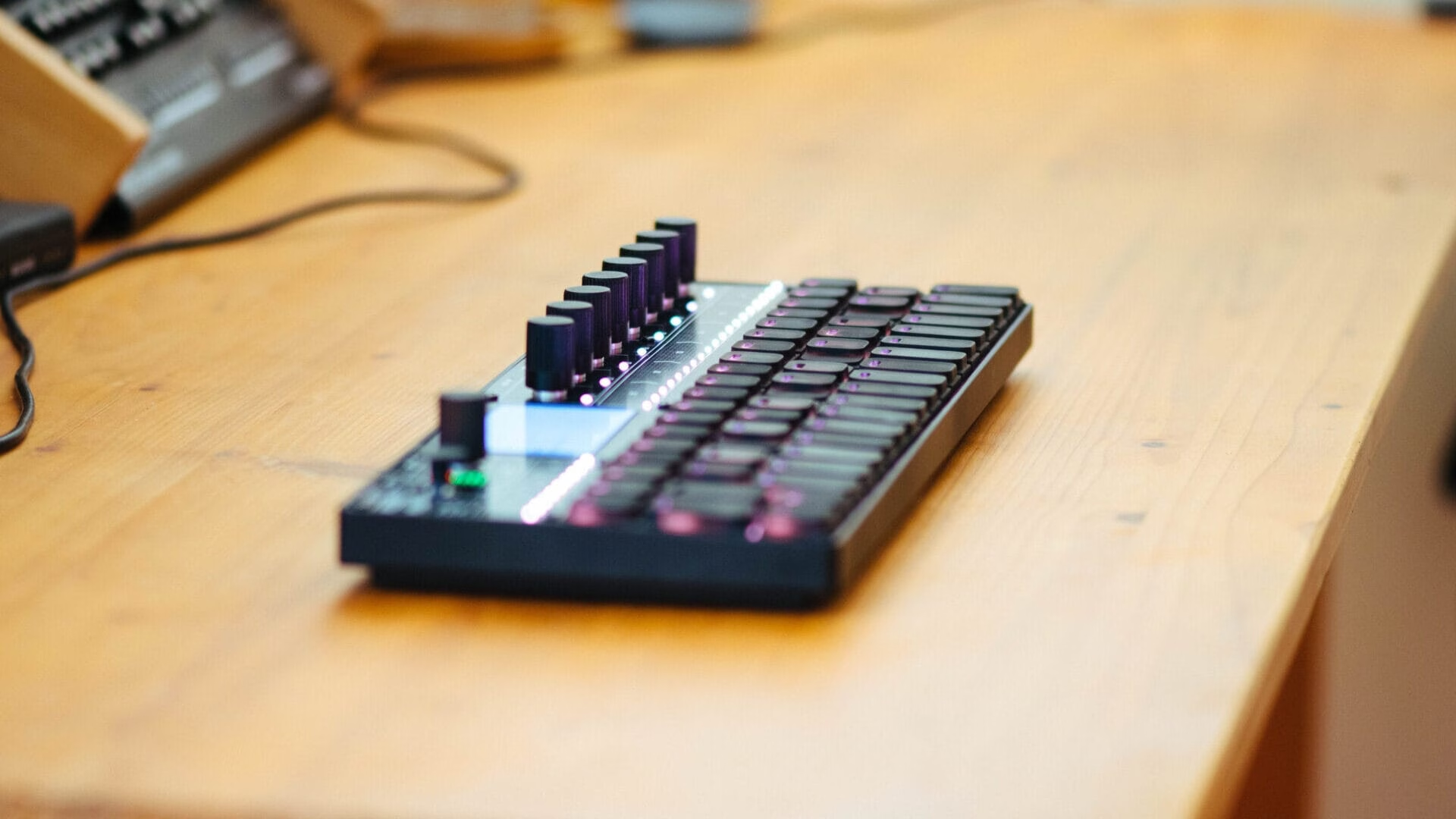
MÕNAI integrates seamlessly into existing setups. USB Host port accepts MIDI controllers, expanding your playing surface. Standard MIDI I/O connects to legacy gear. Four CV outputs – pitch, modulation, velocity, and gate – bridge the gap to modular systems. Line-level audio input lets you process external sources through MÕNAI’s effects. This isn’t an isolated instrument; it’s a hub that enhances your existing workflow.

User Interface
- 52 keys
- 29 piano keyboard layout keys (2 octaves and 1/3)
- 23 function keys
- 8 endless potentiometers
- 2 touch-sensitive strips
- Modulation (left, 8cm)
- Multi-function (right, 20cm)
- 2-axis joystick for expression parameter control
- 6-axis motion sensor
- Volume control knob with audio level indicator strip (stereo)
- High-resolution 3.1″ LCD screen
- Total of 109 LEDs: 88 RGB and 21 single-color LEDs
- 2 microphones for audio recording
- 1 USB port for battery charging and computer connection
- 1 USB Host port for device connection (e.g., MIDI keyboard)
- Line-level audio input
- 2 x audio outputs
- 3.5mm TRS MIDI input and output
- Pedal input
- Sync out / in
- CV outputs
- CV Pitch
- CV Modulation
- CV Velocity
- CV Gate
- Dimensions: 36.5 x 12.3 x 18.7 cm

A Tool for Sonic Exploration
MÕNAI encourages experimentation. The two built-in microphones capture audio for immediate processing or sampling. The pedal input adds hands-free control. The combination of traditional keyboard layout and function keys provides both familiar territory and new possibilities. This is an instrument that rewards curiosity – the more you explore, the more it reveals.

The CNC-machined aluminum enclosure isn’t just aesthetically refined – it’s engineered for durability. Sandblasted and anodized in matte black, the body resists wear while maintaining a professional appearance. The integrated battery means you’re not tethered to power outlets. Whether you’re sketching ideas on a train, performing in a park, or working in a studio without available outlets, MÕNAI adapts to your environment rather than constraining it.

The workflow is immediate. Controls are positioned for intuitive access, with visual feedback from 109 LEDs across the interface. The high-resolution display renders waveforms and parameters clearly. Multiple synthesis engines can run simultaneously, each with dedicated effects and modulation routing. Sequencers maintains precise timing whether you’re working with internal sounds or triggering external gear.


MÕNAI
MÕNAI
MÕNAI
MÕNAI
MÕNAI preview at ADC 2025


MÕNAI preview at LMTA 2025


MÕNAI SDK: Build Your Own Extensions
We’re opening MÕNAI to developers. The MÕNAI SDK, planned for Q2 2026, will let you create custom extensions that run directly on the hardware – no computer required.
Note Effects: Design sequencers, non-traditional rhythm generators, custom arpeggiators, or simpler utilities like chord generators. Your code processes MIDI data in real-time, transforming musical input before it reaches the synthesis engine.
Custom Interfaces: Create visual feedback and control layouts tailored to your extensions. The graphics API provides vector drawing primitives, with the same commands working identically in the simulator and on hardware. Design interfaces that respond to the 8 encoders, touch strips, joystick, and keyboard.
Audio Generators and Effects (coming later): Future SDK releases will expose audio-rate processing, letting you build custom oscillators, filters, and effects that integrate seamlessly with MÕNAI’s signal path.


Development Workflow
Build and test extensions on your desktop using the included simulator. The same code that runs in simulation deploys directly to hardware. Hot-reload capability means you see changes instantly without restarting. When you’re ready, load your extension onto MÕNAI through USB.
Extensions access hardware controls through event callbacks. Respond to encoder turns, key presses, touch gestures, and joystick movements. Set LED colors to provide visual feedback, draw to the display at 60 Hz. The API handles the complexity of hardware timing and resource management – you focus on creative functionality.
Why This Matters
Hardware synthesizers traditionally ship with fixed capabilities. MÕNAI tries to break that model. The SDK turns the instrument into a platform. Build tools that serve your specific workflow. Share extensions with other musicians. Experiment with algorithmic composition techniques that would be impractical to implement through traditional interfaces.
The modular architecture means your extensions integrate naturally with MÕNAI’s existing synthesis engines and effects. Chain your custom note processor before a built-in synth. Route audio through your effect alongside factory presets. The system doesn’t distinguish between built-in and user-created modules.
Join the Early Access
We’re looking for developers interested in shaping the SDK during its development. If you’re attending ADC and want to discuss extension ideas, find us at the poster table. We’ll be sharing technical details, API documentation, and early access information with developers who want to push MÕNAI’s capabilities beyond what we’ve imagined.
The SDK will be free and open. We’re building this for the community of musicians and developers who see instruments as platforms for exploration, not appliances with fixed functions.
Tell us what you think
Do not hesitate to drop us a message